My published books all can be found on Amazon
CLICK ON THE LINK BELOW
Starting university can feel a bit all over the place.
One minute you’re excited about the freedom and new opportunities. The next, you’re sitting in your room—half unpacked, slightly overwhelmed—wondering if you’ve made the right decision.
There’s a lot to adjust to. Deadlines come quickly, routines disappear, and even basic things like cooking or doing laundry suddenly feel like they take more effort than expected.
It’s easy to look around and think everyone else has settled in better than you.
Almost everyone feels like this at some point.
It might not look like it from the outside, but a lot of students are figuring things out as they go. Feeling unsure, behind, or overwhelmed isn’t a sign something’s gone wrong—it’s a normal part of the transition.
The Inside-Out Guide to University Life isn’t about adding more strategies or telling you how to “fix” yourself.
It’s about understanding something more fundamental:
Your experience of university isn’t just shaped by what’s happening—it’s shaped by how you’re thinking about it in the moment.
When your thinking feels busy or pressured, everything can feel harder.
When your mind settles, things often feel more manageable—even if nothing externally has changed.
As you understand this more, a few things tend to become clearer:
Stress feels less overwhelming
Not because deadlines disappear, but because you’re not caught up in the same level of pressure around them
Focus becomes easier
When your mind is clearer, starting and continuing work feels more natural
Confidence shows up more naturally
It’s less about building it, and more about having space for it
You don’t feel as stuck in your own head
There’s more perspective, even during busy or stressful periods
It’s a bit like a snow globe.
When it’s shaken, everything looks cloudy and chaotic. But if you leave it alone, it settles on its own.
Your mind works in a similar way. You don’t always need to force clarity—you often just need to give it space.
The ideas in the book come from a psychological understanding often referred to as the Three Principles—Mind, Consciousness, and Thought.
You don’t need to know the theory in detail. What matters is seeing how it shows up in your day-to-day experience.
If university feels harder than you expected, you’re not the only one—and it doesn’t mean you’re doing it wrong.
Sometimes, a small shift in how you understand your experience can make things feel a lot more manageable.
You can find The Inside-Out Guide to University Life here:
https://amzn.eu/d/07ohTh9t

Most people who struggle with procrastination don’t lack discipline.
If anything, they care too much.
You sit down with the intention to start… and nothing happens.
Not because you don’t want to do the work, but because your mind feels busy, pressured, or overloaded.
From the outside, it looks like procrastination.
From the inside, it feels more like being stuck.
A lot of advice around procrastination focuses on doing more—better planning, stricter routines, more willpower.
But that only works if the issue is effort.
Most of the time, it isn’t.
What’s really happening is this:
When your mind is overloaded—thinking about outcomes, pressure, expectations—it becomes harder to focus and easier to avoid starting.
It’s not a character flaw.
It’s a response to mental noise.
Instead of trying to force yourself through it, it helps to understand how your mind works in the moment.
A few things to keep in mind:
1. Clarity comes before action (not after)
If your thinking feels crowded, starting will feel harder.
Even a short pause—stepping away, taking a breath—can help your mind settle enough to begin.
2. You don’t need to feel ready
Waiting for motivation often keeps you stuck.
Starting small, even without feeling “in the mood,” is usually enough to get things moving.
3. Reduce the pressure around the task
The more importance you pile onto something (“this has to go well”), the harder it becomes to start.
Lowering the stakes—even temporarily—makes action easier.
4. Focus on the next step, not the whole task
Thinking about everything at once creates overwhelm.
Focusing on one simple step cuts through that.
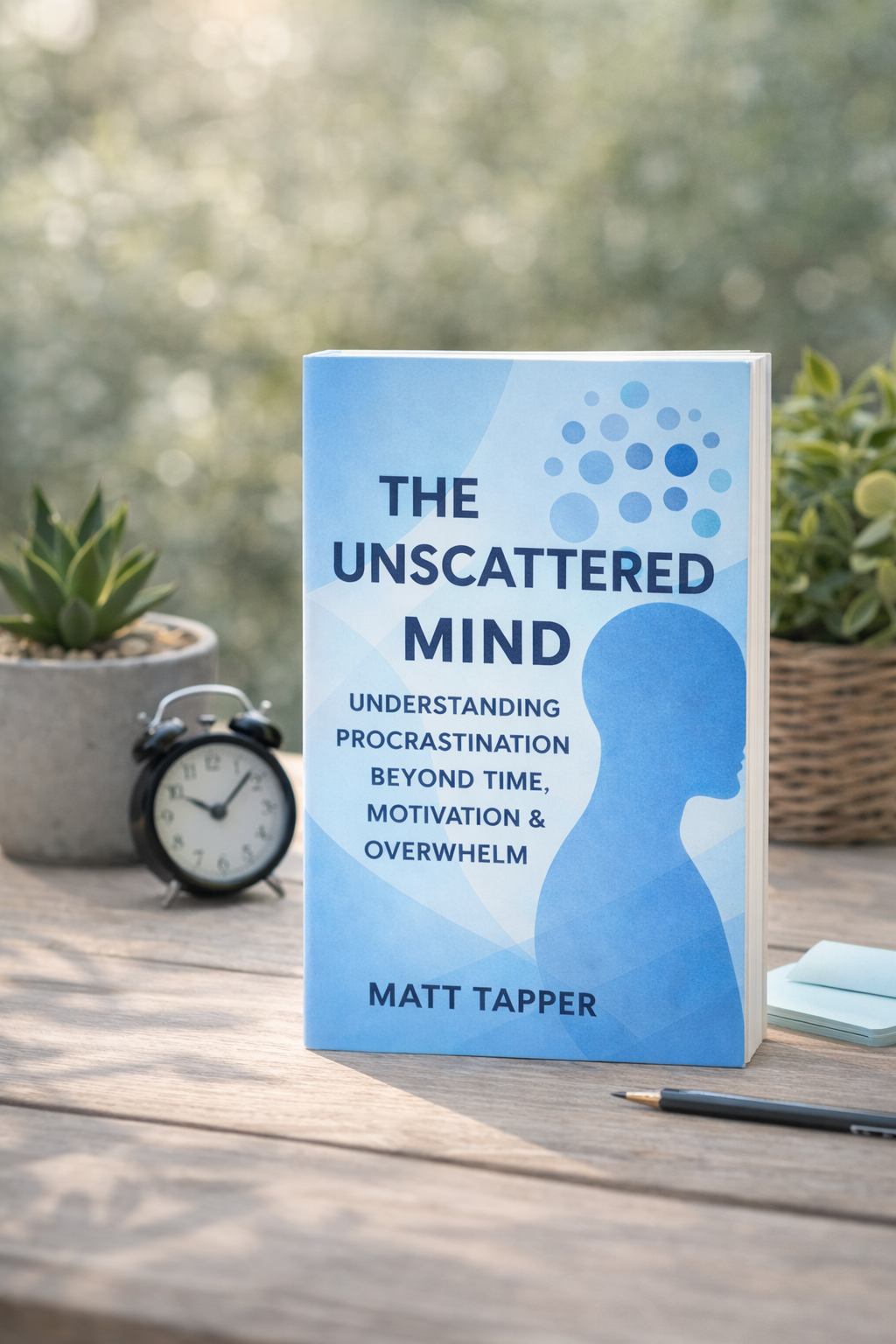
The Unscattered Mind is built around a simple idea:
Focus and motivation aren’t things you force—they’re what’s left when your mind isn’t overloaded.
When your thinking settles, clarity tends to come back on its own.
You’ve probably experienced this already—moments where things just “click” without effort. That’s not something you created. It’s something you allowed.
Imagine looking through a foggy window.
You can try to force yourself to see more clearly—but it doesn’t really work.
Once the fog clears, everything becomes obvious without effort.
Your mind works in a similar way.
If you’ve been stuck in cycles of overthinking, avoiding, and then feeling frustrated with yourself, there’s nothing wrong with you.
You’re just dealing with a busy mind.
Understanding that—and knowing how to let it settle—can make a big difference.
You don’t need more pressure, better discipline, or a perfect routine to move forward.
Often, you just need a bit more clarity—and that’s something you already have access to, once things quiet down a little.
At some point, a lot of students have the same thought:
“Everyone else seems to know what they’re doing… so why don’t I?”
You look around and people seem organised, social, on top of their work. Meanwhile, you might feel like you’re constantly catching up—academically, socially, or just mentally.
Social media doesn’t help either. It tends to show the highlights, not the stress, the uncertainty, or the off days.
So it’s easy to assume you’re the only one struggling.
You’re not.
Feeling “behind” usually isn’t about where you are.
It’s about how your thinking is shaping your experience in the moment.
When your mind is busy—comparing, worrying, overthinking—it creates a sense of pressure that can make everything feel heavier than it needs to.
You might notice thoughts like:
“I should be doing more than this”
“I’m not keeping up”
“Everyone else is handling this better”
The more attention those thoughts get, the more real they feel.
But they’re not a reliable measure of how you’re actually doing—they’re just a reflection of a busy mind.
Instead of trying to “fix” yourself or catch up all at once, it helps to understand a few things:
1. Feeling lost is part of the process
University is a big shift. Not knowing exactly what you’re doing yet is normal, not a sign something’s gone wrong.
2. Your mind isn’t meant to feel clear all the time
Just like your mood changes, your thinking does too. A busy or uncertain period doesn’t mean it will stay that way.
3. Clarity returns on its own
You’ve probably had moments where things suddenly made sense again. That wasn’t something you forced—it happened when your thinking settled.
4. You’re not as far behind as you think
When you’re in your head a lot, it’s easy to lose perspective. Most people are figuring things out as they go, even if it doesn’t look like it.
You Are Not Behind is built around a simple idea:
Your experience of university isn’t just shaped by what’s happening—it’s shaped by how your mind is processing it.
When your thinking is loud and crowded, everything can feel uncertain.
When it quiets down, things often feel more manageable—even if nothing externally has changed.
It’s a bit like the weather.
Some days are clear, some are cloudy, some feel like a storm.
But the sky itself doesn’t disappear—it’s still there behind it all.
Your clarity and sense of direction work in a similar way. They don’t vanish—you just lose sight of them for a while.
If you’ve been feeling behind, lost, or unsure where you’re heading, it doesn’t mean you’re off track.
It usually just means your mind has been under a bit of pressure.
Understanding that can take a lot of weight off—and help you find your footing again.
You don’t need to have everything figured out to be on the right path.
Most people don’t.
And often, the feeling of being “behind” fades quicker than you expect—once your mind has a bit more space to settle.